寿司だけじゃない「食」を通じて知る日本の奥深さ
Written by Masa
Sushiro is opening its first US restaurant in Times Square, New York, in October 2026.
Times Square is not exactly short of places to eat, and New York is already home to plenty of excellent sushi restaurants. So seeing the news about a Japanese conveyor-belt sushi chain opening right in the middle of one of the busiest tourist spots in the world was a bit of a surprise to me.
Sushi really is the face of Japanese food overseas.
Of course, eating sushi in New York can be quite an expensive experience these days, especially when “omakase (trust the chef)” has become such a standard. So if you visit Sushiro in Japan after seeing the prices in New York, you might be pleasantly surprised.
In Japan, some sushi plates at Sushiro are available from around 120 yen, although prices vary depending on the restaurant and the type of sushi. And you don’t even have to go to a sushi restaurant. Japanese supermarket sushi can be surprisingly good, too.
So, I would love visitors to try Sushi in Japan, but it is certainly not the only thing.
My Friend’s Surprising Favorite

A few years ago, I asked a friend who had travelled to Japan:
“What was your favourite meal?”
He showed me a photo on his phone, with a big grin, and it was a mixed-fry set meal.
I looked at the photo and couldn’t help grinning back.
The photo was of a typical Japanese food sample – one of those very realistic wax or plastic displays often placed outside casual restaurants. Some of them look remarkably like real food.
The mixed-fry set meal had a large deep-fried prawn, tonkatsu, crab cream croquette, shredded cabbage, tomato, cucumber and the obligatory potato salad!
Not exactly exotic. And that was exactly the point.
I couldn’t help thinking that, apart from people who don’t like seafood, there probably aren’t many Western visitors who would dislike this.
It is familiar enough to feel comfortable, but it is also very Japanese.
And there are plenty of other Japanese deep-fried foods that I would recommend.
If you like pork, try tonkatsu. Definitely.
If you like seafood or vegetables, try tempura.
A really good tonkatsu restaurant may use a particular type of oil and carefully chosen pork, and serve it freshly fried. The same goes for tempura.
There is a Japanese word, kodawari, which is often used when someone is particular about the details of what they do. Good restaurants and cooks can have an incredible amount of passion and commitment to getting those details right.
Enjoy the food. And enjoy the craftsmanship behind it.
If You Like Unagi (Grilled Eel), Eat It in Japan
If you already enjoy the vacuum-packed eel that is flown overseas and sold in your country, I would really like to see your face when you try good unagi in Japan. I wonder what word you would use to describe the experience.
“Wow”? “Really?” or “Oh my…!”
Or perhaps you would just keep eating.
This is another way of discovering Japanese food. Try something you have already experienced.
You may be surprised by how different it can be when it is freshly prepared in Japan by specialists, using local ingredients.
Sometimes, you don’t need to try something completely new!
And then there are two things that may not immediately come to mind when you think about Japanese food:
Mister Donut and MOS Burger
Missing Dunkin while you’re in Japan? Try Mister Donut.
Missing McDonald’s? Try MOS Burger.
I’m not saying they are exactly the same. That’s the fun of it. You may already know doughnuts and hamburgers very well, but in Japan, they have their own Japanese twist.
So why not try something familiar – and see what happens when it becomes Japanese?
Believe me, they are good, and they are worth trying!
And Don’t Forget the Convenience Store
When another couple of friends asked me, “What can we get for breakfast?”, my answer was:
“Find the nearest convenience store — preferably one of the major chains.”
They have tea, coffee, sandwiches, rice balls, fried chicken, noodles, bento and sweets. The choice can be almost overwhelming.
Japan’s convenience stores are not just places to buy drinks and snacks when you are in a hurry. They are also a surprisingly good place to explore everyday Japanese food.
You might walk in thinking you will just buy a bottle of water and walk out with an onigiri, an egg sandwich, some fried chicken and a dessert. It’s true. It happens.
For visitors, a convenience store is also an easy way to try things you might not want to order in a restaurant — just check the package, buy one, and take it back to your hotel. If you don’t like it, you haven’t spent much on a restaurant meal, and if you love it, you may have discovered something you never thought to try.
Of course, convenience-store food is not the same as eating a carefully prepared meal at a good Japanese restaurant.
That’s not the point.
It gives you a glimpse of what people in Japan actually eat when they want something quick, easy and reasonably good. And that, too, is part of Japanese food culture.
The Magic of Hotel Breakfasts and Izakayas
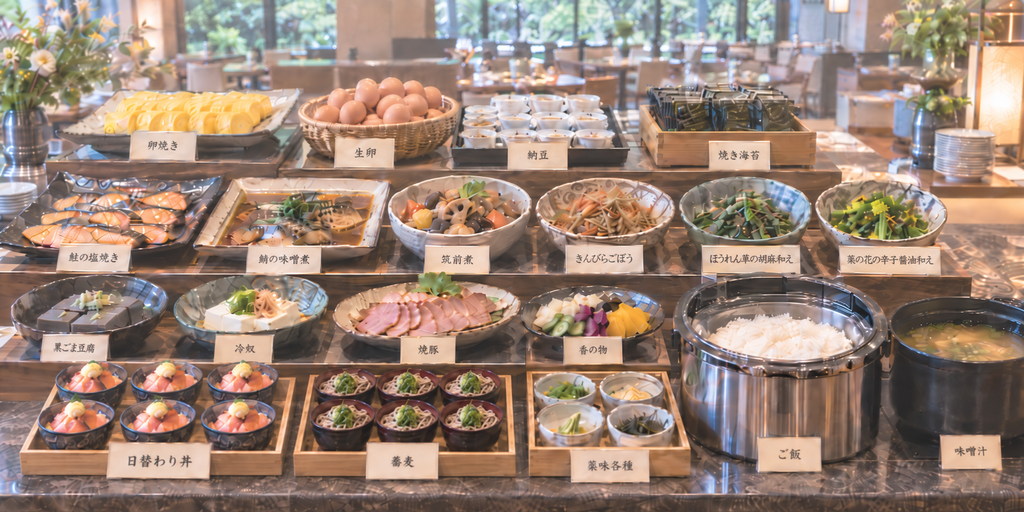
If you are not so familiar with Japanese food, there is another easy way to try a little bit of everything: a hotel breakfast buffet.
You often find common Japanese breakfast dishes such as grilled fish, tamagoyaki, raw eggs, natto, rice, miso soup, Nori seaweed, tofu, pickles and other side dishes.
There will usually be Western breakfast items too — scramble eggs, sausages, salads, bread, cereals, fruits etc.
So it isn’t a bad idea to choose some hotels with a good breakfast during your trip.
Izakayas can work in much the same way.
Izakayas can work in much the same way.
Izakayas are casual Japanese pubs, although you don’t necessarily have to drink alcohol (there are exceptions!). They usually have lots of small dishes, so you can order several things and share them.
Yakitori, kushiage, sashimi (sometimes crab and oysters too!), tofu, pickles and many other dishes such as cooked vegetables might all appear on the same table.
For a first-time traveller to Japan, I think these are good strategies. You don’t have to commit to a whole meal of something you’ve never tried before. Try a little bit of many things. Then, when you find something you really like, go back and get more, or eat it again at a restaurant that specialises in it.
This way, you can explore Japanese food without taking too many risks.
Japanese food as a culture
Japan has become much more accessible, and it is now easier than ever for foreign visitors to travel around the country and explore places beyond the typical tourist spots.
I hope you will have a wonderful experience in Japan – and especially through its food.
Because Japanese food is not just fuel. It is part of everyday life!
And now, what would you like to eat in Japan?